WELCOME TO THE COMMUNITY
find what you are looking for or ask a new question
Home > Forum > Latest posts

latest posts

WEBCON
In reply to: MariaM

Global search isn't working for the new items because they're still stuck in the processing queue. The queue is decreasing, but quite slowly. Based on the current rate of around 40k items per day, it would take approximately 20 days to clear the remaining 800k items.

Hi Maria,

Generally speaking, every save made to a workflow instance will add (at least) two entries to SOLR indexer queue:
a) update instance data in Solr (for searching and SearchIndex report purposes)
b) register user's activity (for users' last activities)
If your Solr server was not responding for a period of time, it is possible that tasks in the queue multiplicated, eg. there are 10 tasks to update the same workflow instance (unnecessary).

One possible solution to deal with such scenario is to first remove all tasks from SOLR indexer queue and then add a new task "Reindex all databases". Instead of updating each entry in Solr X times, it will be updated once.
However, there is a risk that users' activities in queue will be lost, because they cannot be reindexed (they are stored only in Solr). If you remove them from queue before they're indexed, they will be lost forever.
Depending on your needs, this may still be a better option than waiting 20 days.
Details on Solr indexer queue options can be found in https://community.webcon.com/posts/post/report-solr-indexer-queue/274/26

Since WEBCON 2024, there are separate queues for indexing instances, attachments and activities, which means that you could remove tasks only from instances and attachments queues (probably directly on SQL database) and activities would remain unchanged (no user activities would be lost). This is not possible on older WEBCON versions, because there is one common queue for every Solr indexing task.

There are other risks related to "Reindex all databases" task to consider:
- when reindexing a process/entire database, workflow instances are batched (by default data of 500 instances is sent at once), which is generally faster, but more demanding on Solr server, so more resources may be required for the period of reindexing
- reindexing can block a current/ongoing indexation, so you may consider reindexing after business hours

If you're on version 2023 or older, I'd strongly suggest upgrading ASAP, as there were major optimizations made to Solr queues and indexing. It will help you avoid similar problems in the future.

Kind regards

WEBCON

Hi Dheeraj,

To add to Maks's response, here is some additional information which I hope can be useful for you:

Ad 1. and 2.
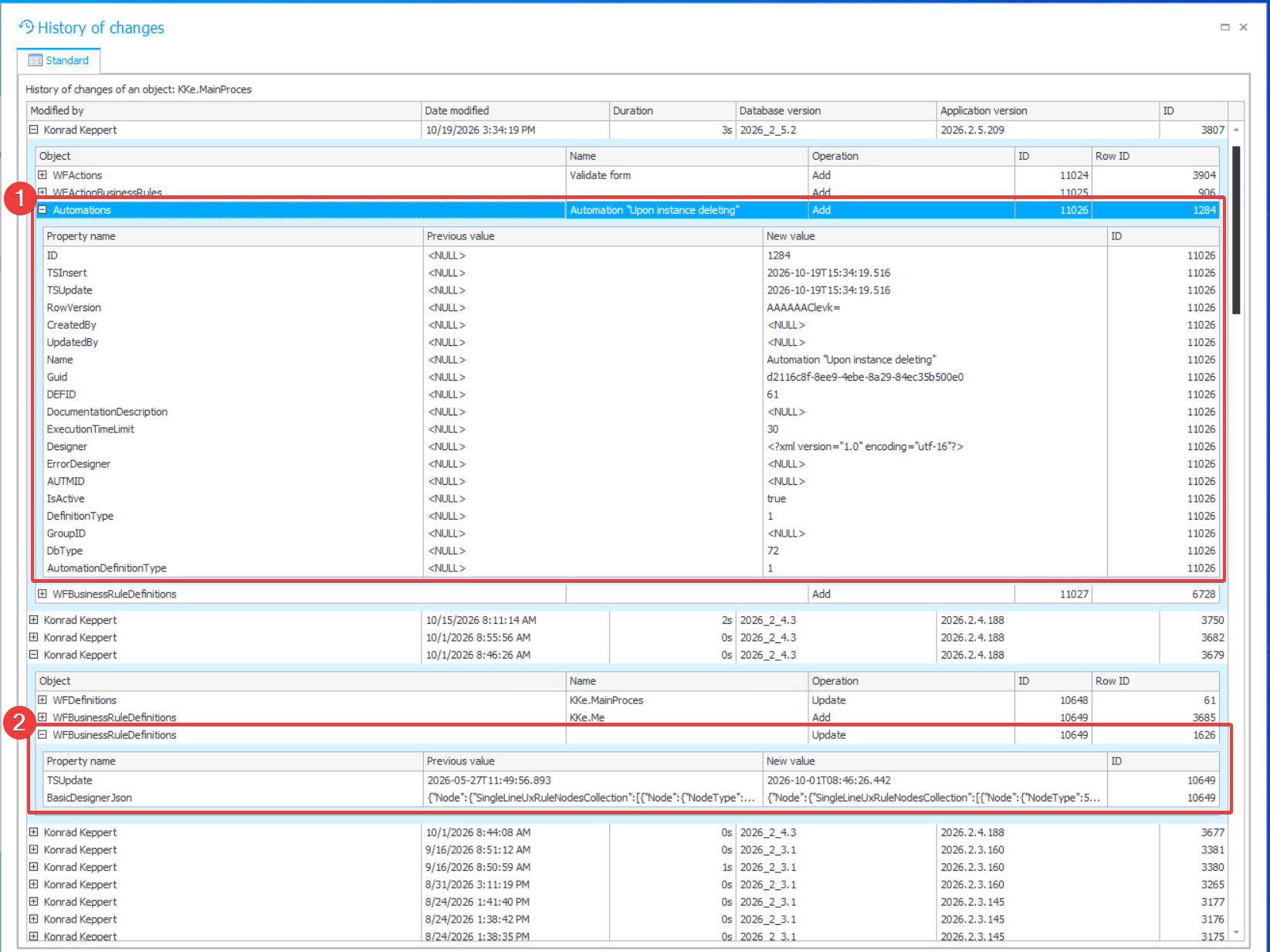
the History of Changes in Designer Studio *does* show every change that was made to a process - rules, actions, form fields etc.
Each top-level row is one save made to a process, then you have to expand that row to see changes made on that particular save. If you can't see any meaningful changes, then probably there were no modifications on that save.
See attached screenshot as an example: we can see a new automation being added (1) and a business rule being modified (2).

Ad 3.
If you have access to content database, then every save made to a process (both Studio saves and BPE imports) can be seen in tables:
- dbo.HistoryImports (general info, such as platform version, user login, save/import flag and duration)
- dbo.HistoryImportEntities (guids of objects that were saved - in relation to HistoryImports)
- dbo.HistoryImportDatas (detailed information of changes made on save in each table + JSON with changes applied on save)
Keep in mind that all of these tables are used to display History of Changes, there is no more information that you can see in Studio.

Other tables such as dbo.ChangeRows, dbo.ChangeDetails mentioned by Maks are showing only global configuration changes (eg. data sources, HotMailBoxes, global permissions). They do not store changes made to applications/processes.

If you have ideas how to improve the History of Changes view, I encourage you to share your thoughts/ideas on https://community.webcon.com/user-voice

MVP
In reply to: Marcin Majka

We work on extensive processes, where the form scope is also a limitation for us. As a result, we often have to split a single process across several forms. We also do a lot of integrations, and the User-defined API has already been a lifesaver for us. It would be great to see support for domain entities, meaning the ability to receive and map more complex, structured objects (with nested objects and lists) directly onto the process data model, without having to flatten the contract or add intermediate parsing logic.

Are there any plans to extend the User-defined API or the data model in this direction? If this is on the roadmap, we would be grateful for any information on the expected timeline.

Hi Marcin

Did you try a UDA with only one text propert e.g. data and transfer your the stringifyed json?
e.g.
{
"data": "{\"suppliers\":[{\"hqAddress\":{\"street\":\"Domaniewska 1\",\"city\":\"Warszawa\",\"postCode\":\"02-672\"},\"postAddress\":{\"street\":\"Prosta 10\",\"city\":\"Warszawa\",\"postCode\":\"00-001\"}}]}"
}

The automation of your endpoint stores the json in a local variable.
Then you use SQL and the JSON_VALUE function to extract the values:

SELECT
JSON_VALUE('Your local Variable', '$.suppliers[0].hqAddress.street') AS HqStreet,
JSON_VALUE('Your local Variable', '$.suppliers[0].hqAddress.city') AS HqCity,
JSON_VALUE('Your local Variable', '$.suppliers[0].hqAddress.postCode') AS HqPostCode,

JSON_VALUE('Your local Variable', '$.suppliers[0].postAddress.street') AS PostStreet,
JSON_VALUE('Your local Variable', '$.suppliers[0].postAddress.city') AS PostCity,
JSON_VALUE('Your local Variable', '$.suppliers[0].postAddress.postCode') AS PostPostCode

In reply to: Patryk K

Looks like your SOLR was not indexing stuff for a while... Was your global search working at all? I would wait for the queue to offload if it goes smoothly and then check how the daily indexing looks like.

Global search isn't working for the new items because they're still stuck in the processing queue. The queue is decreasing, but quite slowly. Based on the current rate of around 40k items per day, it would take approximately 20 days to clear the remaining 800k items.

MVP

Hi Dheeraj,
Only thing that is provided in Designer Studio Legacy(there is a new web one coming soon) is that History of Changes - the best one too look at is the one at Process level, not on Application.
I'ts not great, but you can sometimes see there some tips what could have been changed - it's easy to check if update was for example only for permissions.

You could try to use ChangeRows table to make some custom searches/reports - they will describe what have changed, but i'm not sure if you'll get how it changed. (db docs will come in handy*)

When it comes to auditing, we're avoiding any manual work on PROD environment and only few users have access to that environment, if there is a change in the application it goes full process DEV -> TEST -> PROD, so there are only imports in most cases (we do have some exceptions, like modifying reports, but under a strict rule that it has to be applied on all environments manually at same time). To ease out importing DEV -> TEST -> PROD you can take a look at importing applications via API endpoint**.

With standardized process, and written changelogs for each versioned package - you know what changed. If you need business description - there is currently no AI for that 'yet', you'll have to create them.

* https://developer.webcon.com/2026/resources/db/
** https://community.webcon.com/posts/post/importing-applications-using-the-public-api/461/3

Hi Everyone,

I am trying to audit recent changes made to a WEBCON application and its workflows.

I can see entries in the History of Changes section, but many of the changes appear to be technical updates such as TSUpdate, SaveStamp, or DesignerData. It is difficult to determine which changes actually affected the workflow logic, business rules, paths, actions, forms, or configuration.

My questions are:

1. Is there a built-in way in WEBCON to see the exact functional changes made to an application or workflow?
2. Can WEBCON show what was changed (e.g., workflow path, action, business rule, form field, SQL query, etc.) and not just that a save occurred?
3. Is there a database table or report that can be used to compare workflow versions and identify meaningful changes?
4. How do you typically audit changes between two application versions?

For example, I can see changes in properties such as DesignerData that contain workflow diagram coordinates and connector paths, but I am looking for a way to identify actual business or process changes.

Any recommendations or best practices would be greatly appreciated.

Thank you!

My experience is that it just doesn't work 90% of the time.
If and when it does, it can actually do something useful but in most cases it simply fails on agent timeout or other errors that are not clear to an user, which makes this confusing and no one wants to use it.
I've been trying to fill a form today 20 times, succeeded twice.
Interestingly, depending on a model it seems to be have different capabilities - when using Gemini - it could retrieve attachment from opened form, when using GPT it simply says - no way, you need to upload to chat.
And on GPT it just fails on loading attachment to the model which for example for contract makes it useless.

Hello,

We are using the WEBCON Mobile application for asset management and QR code scanning.
When using a form field with the Enable QR scan option enabled, the scanner opens, reads a single QR code, transfers the value to the field, and then closes.
We would like to know whether WEBCON Mobile supports a continuous scanning scenario where:
- the camera is opened only once,
- multiple QR codes can be scanned sequentially,
- the scanner remains active after each successful scan,
and all scanned values are accumulated and returned to the form when the user finishes scanning.

Example: Open scanner once → Scan QR #1 → Scan QR #2 → Scan QR #3 → Done.

Is such functionality available in WEBCON Mobile?

Thank you.
P.S WEBCON version: 2026.1.3 and WEBCON Mobile App (Android)